
Why the news industry needs to invest in creator-model journalists
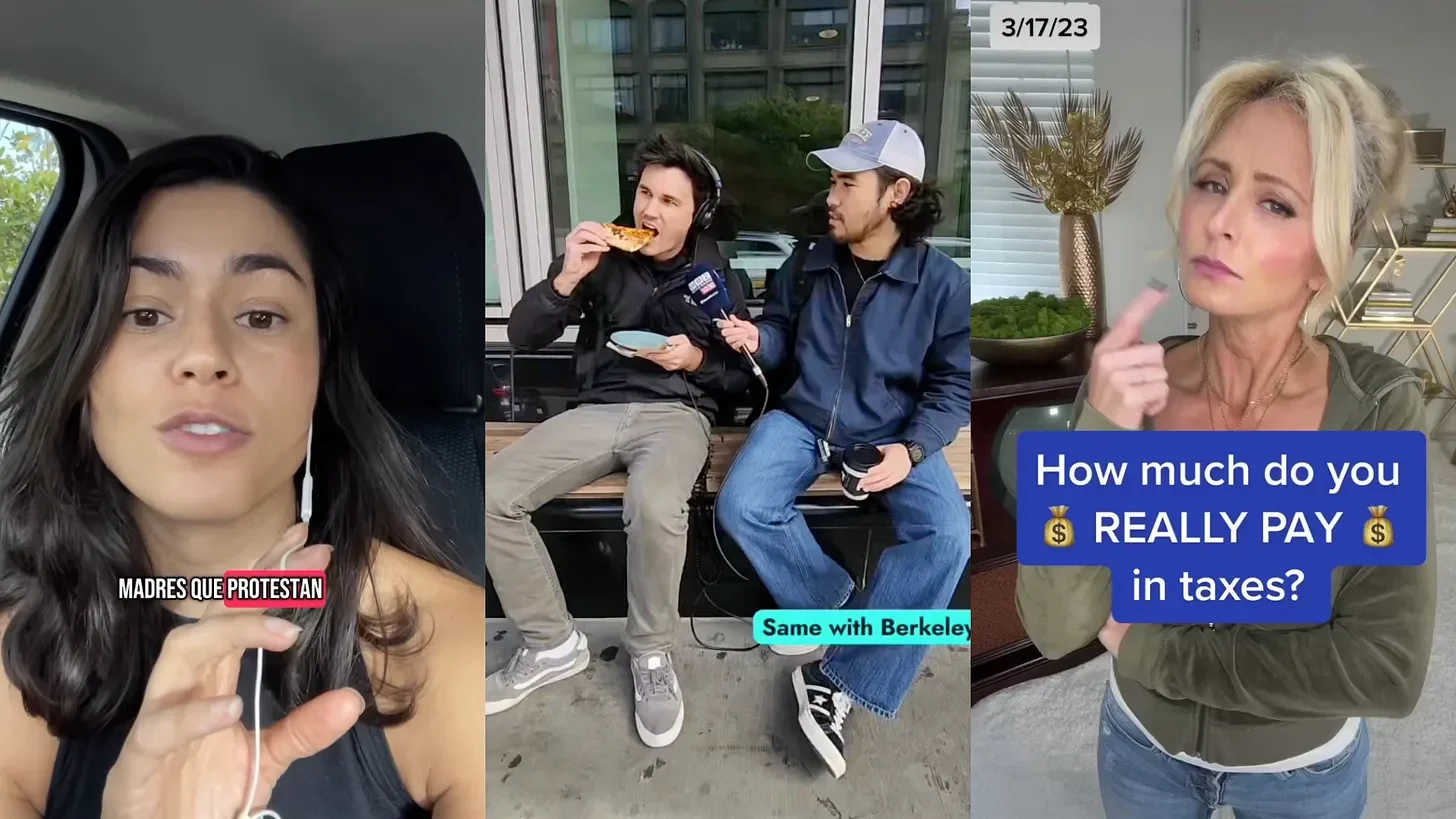
Screenshots of the feeds of Bianca Graulau (left), Matt Shearer (center left) and Lisa Remillard, creator-model journalists who have built audiences on social media
Matt Shearer is not your typical local reporter.
You won’t recognize him by his byline, but you might recognize his handle, “@reportermatt,” on TikTok and Instagram. While other video journalists agonize over every shot and angle of their stories, Shearer cuts together video clips that include theatrical mistakes, like dropping his equipment bag or a bystander stepping in front of his camera.
He’s in the field, speaking with members of the community for insight—but in his own way, like eating pizza with them or jamming to rock music. All the while, Shearer ‘breaks the fourth wall,’ talking directly with his audience and using his personality to connect with people across New England and share their stories. It’s a unique and wildly popular style of reporting that has reached millions online for WBZ NewsRadio—a 103-year-old news outlet long known for the highest standards of traditional journalism.
“At the end of the day, it’s about being real,” Shearer said. “Overly polished and perfect feels inauthentic on social media. Most of what people see as they scroll is literally someone who just turned on their phone and started talking.” His audience doesn’t expect perfection.
Shearer is one of many reporters now embracing “creator-model journalism”, a form of storytelling that relies on individuals using their personal brand and social media platforms to tell stories and inform communities. This way of reporting has changed how many people get their news and questioned the very definition of journalism.
“Traditional journalists have this rule book of what they can and can’t do, how they’re supposed to sound and look. For me, it’s fun to inject personality, humor, and just tell stories in a way nobody else is going to tell them… I talk to the people who watch my videos the same way I’d talk to a friend.”
According to the Pew Research Center, a little over half of U.S. adults (54%) now get news from social media at least sometimes — more than ever before. Specifically, 36% get news from Facebook, 32% from YouTube, and 17% from TikTok. Additionally, about one-in-five Americans say they regularly get news from people on social media, and around two-thirds of these Americans say that information helps them better understand current events.
Recognizing these trends, some traditional newsrooms are hiring digital journalists or training reporters to become “content creators,” producing social media videos such as interviews, live streams, news summaries, and, most famously, skits.
However, trust in legacy media outlets is slipping, with a Gallup poll finding that 36% of U.S. adults now say they have “no trust at all” in mass media to report the news “fully, accurately, and fairly.”
This, along with the layoffs and other business challenges of the media industry, has led many independent reporters to abandon traditional newsrooms and become “creator journalists,” to meet audiences where they are and build trust directly. Though many of these journalists typically don’t have the benefits of an editor like Shearer, their newsroom experience and nature of being “independent” boost their perception of trust, especially for young people. In fact, according to the American Press Institute, 16-to-40-year-olds are twice as likely to pay for news if the reporting comes from an individual news creator rather than a brand.
Some examples of “creator journalists” are:
Lisa Remillard (a/k/a (“The News Girl), a local news anchor for more than 15 years, who helps people on TikTok digest news about the federal government with her whiteboard and spatula.
Brian Fung, a former CNN reporter, who live-streams first-person shooting games while talking about tech policy on Twitch.
Bianca Graulau, a visual journalist who left NBC in 2020, reports on Puerto Rico and the Hispanic community through community stories and her unique perspective on YouTube.
However, in today’s social media landscape, “content creator” carries a very specific meaning, according to Liz Kelly Nelson, the founder of Project C, an organization that supports and studies creator journalists.
Nelson describes content creators as people who produce material mainly for social platforms—ranging from TikTok dance clips to Instagram beauty tutorials to Twitch gaming streams.
A creator journalist, on the other hand, according to Project C, is
“an individual who combines elements of journalism with content creation techniques to produce news, stories, or informational content for digital platforms. Unlike traditional journalists who typically work for established news organizations, creator journalists operate independently or as part of alternative media outlets, utilizing platforms like social media, YouTube, podcasts, newsletters, and blogs to disseminate their work.”
This means “creator journalists” often rely on subscriptions, ad revenue, or monetization programs from social media platforms to sustain themselves. According to a Goldman Sachs analysis, this “creator economy” is expected to double and be worth half a trillion by 2027.
But the business of the “creator landscape” is also where the power of social media becomes dangerous, and potentially can amplify misinformation and disinformation.
In the creator economy, revenue often depends on the success of audience engagement (likes, comments, reshares) to boost subscription, brand deals, ad revenue, or rewards from social media-led monetization programs.
This is especially true for “news influencers,” another group different from “creator journalists.”
Nelson says "news influencers” are the “opinion section” of the news creator landscape, and “they know how to leverage the social media algorithm.” However, “what tends to pop is content that is inflammatory, that causes a big reaction and goes viral.”
Pew Research found that 77% of these "news influencers" don’t have journalism experience, and are primarily conservative men. The most popular — from right-wing personalities like Joe Rogan and Charlie Kirk to left-wing figures like Hasan Piker and Ron Filipkowski (MeidasTouch) — drive engagement through opinionated content and further blur the lines between who is a "creator journalist” with editorial principles and a “news influencer.”
This is even more dangerous when “news influencers”, especially those covering national politics, collaborate with politicians and political parties, allowing partisan talking points to reach millions of people at a time when partisanship is already at an all-time high.
“Their content is often divisive and polarizing, and it gets pushed to the top. There's so much of it from news influencers that for many people, that's becoming their experience of news. It allows mis- and disinformation to spread, and pushes people into increasingly polarized sections of the internet. It's almost like there are a hundred different ecosystems you can be part of, because what TikTok surfaces to you is different from what it surfaces to me, based on what I keep clicking,” Nelson added.
Although these concerns are a growing reality for the news industry, there are "news influencers" who want to use the principles of journalism to better their content and that of local newsrooms. However, philanthropic and journalism organizations have not stepped up to the plate to support these "news influencers” with programs or training. Nor have enough of them supported independent reporters trying to become "creator journalists" through funding for reporting projects, general operations, and digital strategy tools.
Too often, "creator journalists” are dismissed for being too lighthearted, lacking quality of content, or straying from the seriousness and structure of a traditional newsroom. But creator journalism is inherently different because it adapts to the audience. Unlike traditional news—but similar to local news—creator journalism is about building community.
As news deserts grow across the country, some creator journalists are helping fill those gaps with their content creation or entire community-based newsrooms, such as Bryan Vance’s Stumptown Savings, a newsletter in Portland, Oregon, specifically for grocery prices, or Esta es la Cosa, a Spanish-language YouTube channel for the Hispanic population in Atlanta, Georgia. Their work is also helping to expand the representation of journalists of color and different socioeconomic backgrounds in leadership roles, while helping engage underserved communities nationwide.
For established local newsrooms, "news influencers” can play a vital role in transforming their audience engagement, either teaching journalists the best digital practices or creating content for their communities. This can significantly boost their reach and revenue stream as more people outside of their community discover their newsroom.
However, this can only happen if journalism organizations take audiences seriously and acknowledge that the way people consume their news has fundamentally changed. And just like journalism needs a seat at the AI table, creators need to be a part of building a news ecosystem on social media that uses the principles of journalism and directly engages with communities.
“Journalism is being attacked on all sides. But there’s some optimism with creator-modeled journalism…Publishers need to be thinking about how to partner and grow some of that creator talent together, and help make use of that expertise, bring audiences, and exchange value in that way. The idea that you can be an expert on something that no one else is an expert, that fuels you as a human … and publishers should be the ones creating the resource-rich, optimistic future where that thrives,” said Ryan Kellett, Nieman-Berkman Fellow at Harvard University, who teaches a creator journalism course at the school and works as a consultant with Project C.
If journalism fails to meet its audiences where they get their news, "news influencers" will further dominate this news ecosystem, especially for younger audiences, who primarily get their news from social media. And, more notably, we will be failing the next generation of journalists, who may not want to be traditional reporters but instead be “creator journalists,” especially Gen-Zers. According to a 2023 Morning Consult survey, 57% of people in this age group say they want to be influencers.
“The journalism industry has to take advantage of the fact that most young people today want to become creators,” Kellett said. “Journalism can’t help you if you want to be a basketball star, but journalism can help if you want to become a creator. Instead of publishers wringing their hands about it, they need to take advantage of that and say: maybe they [the next generation] don’t want to go to journalism school, but they do want to be in the creator space.”
This was first published in the GroundTruth newsletter on Substack
